Could AI Data Center Risk Reach American Retirement Savings?
An economist's op-ed argues that US retirement money could end up exposed to AI data center risk by way of private equity, pointing to the place where a data center building boom meets changing retirement plan rules.
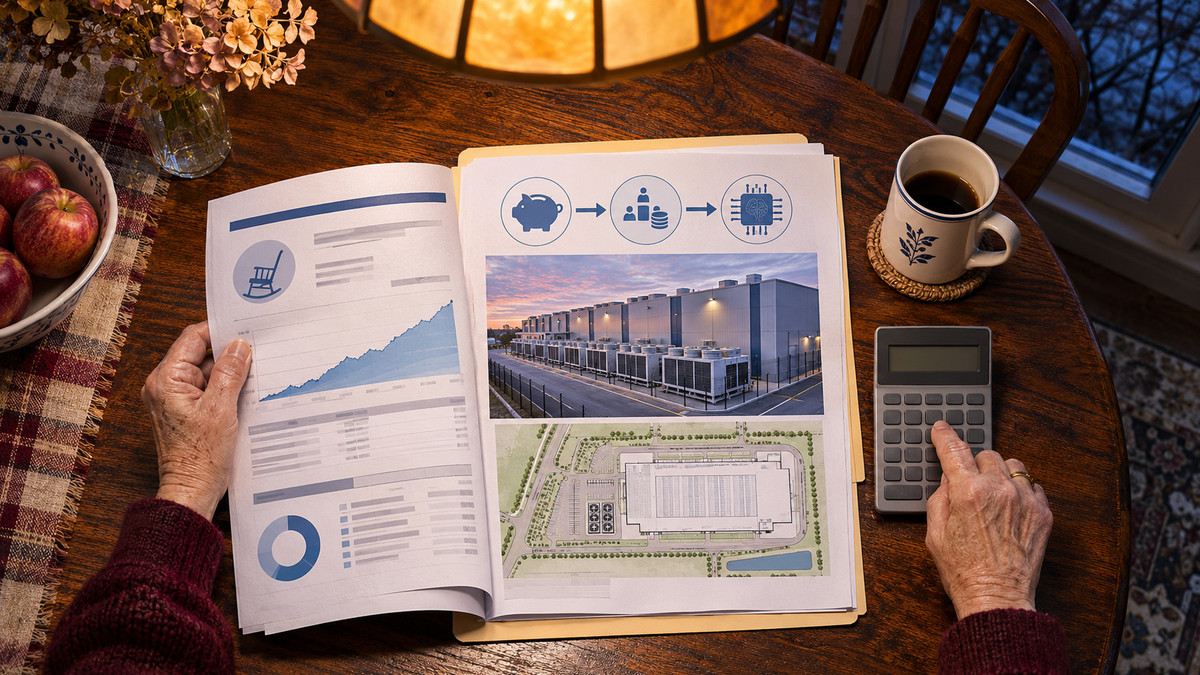
An op-ed by an economist arguing that US retirement savings could end up absorbing the risks of AI data center investment was published on November 9. The piece, which appeared on the LPE Project, ties together private equity’s data center investments and shifts in retirement plan policy. The claim: if enthusiasm for AI investment cools, retirement nest eggs could be shaken too.
How retirement money finds its way in
The channel the piece identifies is private equity. Americans for Financial Reform, a US financial reform group, explained in an October report that private equity firms buy data center operators, take equity stakes in facilities, and sometimes lend directly. Among the investors placing money with these funds, the report noted, are public pension plans.
Data centers with private equity involvement account for somewhere between a quarter and 30 percent of operating facility capacity in the United States. The report estimated that, as of the end of 2025, 78 private equity firms owned or financed roughly 670 facilities in operation. Those facilities represent 13 to 17 GW of capacity, or 25 to 30 percent of the 54 GW total across the US.
Private equity’s share of what gets built next is large as well. Related capacity in the development, construction, and planning stages tallied by the report comes to at least 26.8 GW. That is more than half of the 50 GW planned across the US through 2030.
How the rules for retirement investing are changing
The US government has signaled a move toward widening the range of investments retirement plans can offer. In an August 2025 executive order, the White House said it would lower barriers to alternative asset investment in defined contribution retirement plans such as 401(k)s. The term “alternative assets” refers to equity and debt that are not traded on public markets, as well as real estate and infrastructure investments, among others. Citing the potential to diversify holdings and improve risk-adjusted returns, the administration directed regulators to revisit existing guidance.
What changes for plan participants is the menu of investment products available inside the plan. Which products actually make it into a plan depends on the judgment and duties of the fiduciaries who run it.
$15 trillion in retirement assets: how much is at risk?
The $15 trillion figure that comes up in this debate is the total size of US defined contribution retirement plan assets. According to the Investment Company Institute, those assets stood at $15 trillion as of the end of June 2026, with 401(k) plans accounting for $10.8 trillion. How much of that money is in fact connected to AI investment is what determines the scale of the risk.
The op-ed frames the AI investment boom not as a question about data center construction but as a question about how retirement money is managed. Its author argues that if an AI bubble deflates, retirement savings could be left holding the losses. Both the report’s scope and the executive order’s reach are limited to the United States. What to watch from here is which investments end up inside retirement products, and whether the planned data centers actually get built and turn a profit.