IBM Releases Granite Previews Built to Filter Malicious Commands Hidden in Documents
LLMON, a format that tags instructions and data separately, has been applied to two Granite 4.1 based models. IBM says it cut the rate at which models follow malicious instructions while keeping general performance on par with its existing models.
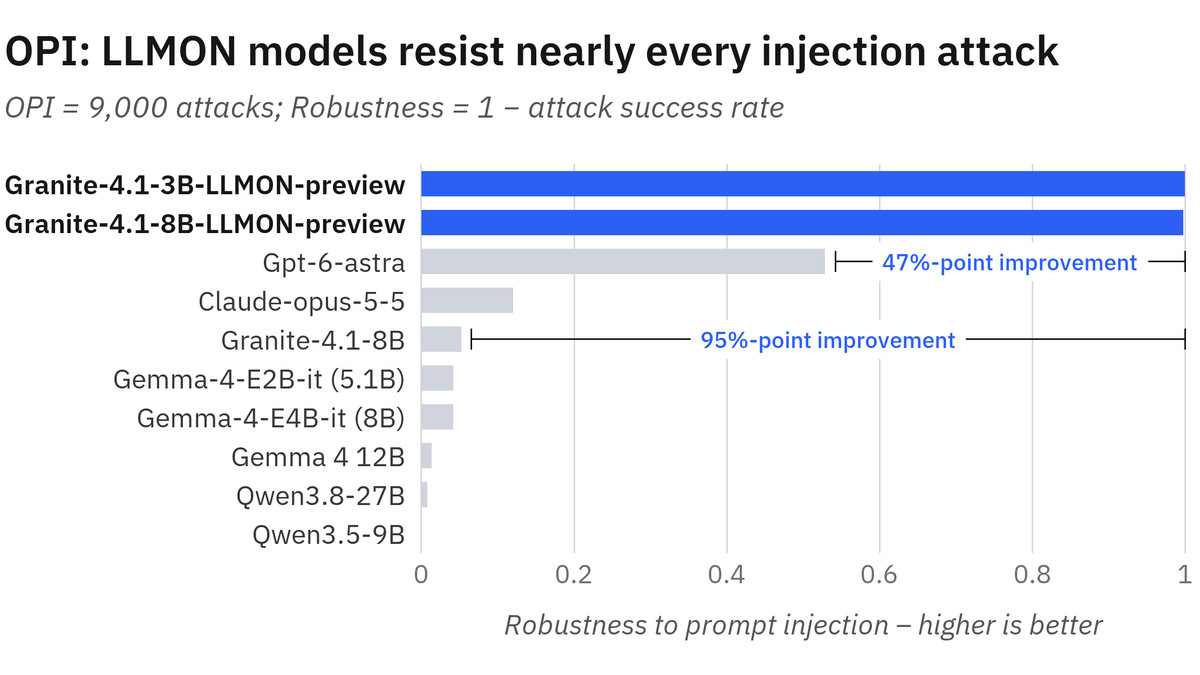
IBM released two preview AI models on November 12 (local time) built around LLMON, a format that explicitly separates instructions from data. The models, granite-4.1-3b-LLMON-preview and granite-4.1-8b-LLMON-preview, are both based on Granite 4.1. IBM also published a GitHub repository with companion tooling and task examples.
How it filters commands hidden in documents
The problem LLMON targets is malicious instructions buried in the material an AI reads. If an attacker slips a command into a retrieved document or the response from an external tool, the model may follow it as though the user had issued it. That is exactly why keeping source material and commands apart matters for AI systems that answer from documents or call external tools.
LLMON marks three things separately: the instructions to carry out, the data to read, and the constraints an answer must satisfy. It also links which instruction applies to which piece of data. Ask for a company overview with a length limit, for example, and the request itself, the company name, and the length constraint are each bundled into distinct regions. IBM says the approach also reduces the problem of unrelated sentences or stale conversation turns bleeding into answers.
Conventional chat formats only indicated who was speaking, such as system or user. LLMON goes further and marks what each piece of content is for and how the pieces relate to one another. JSON, the format commonly used to carry such material, mixes quotation marks and brackets into both content and structure. LLMON instead reserves dedicated markers for structure. IBM says the design lets the model distinguish complex structure easily even in long inputs.
How far did attack success rates fall?
IBM reports that on OPI, a benchmark that injects malicious instructions into data drawn from ordinary natural language processing tasks, the attack success rate for the LLMON models dropped to nearly zero. It says the ASB and StruQ benchmarks showed a similar pattern. On general capability benchmarks, the models scored on par with the Granite 4.1 Instruct models, the company added.
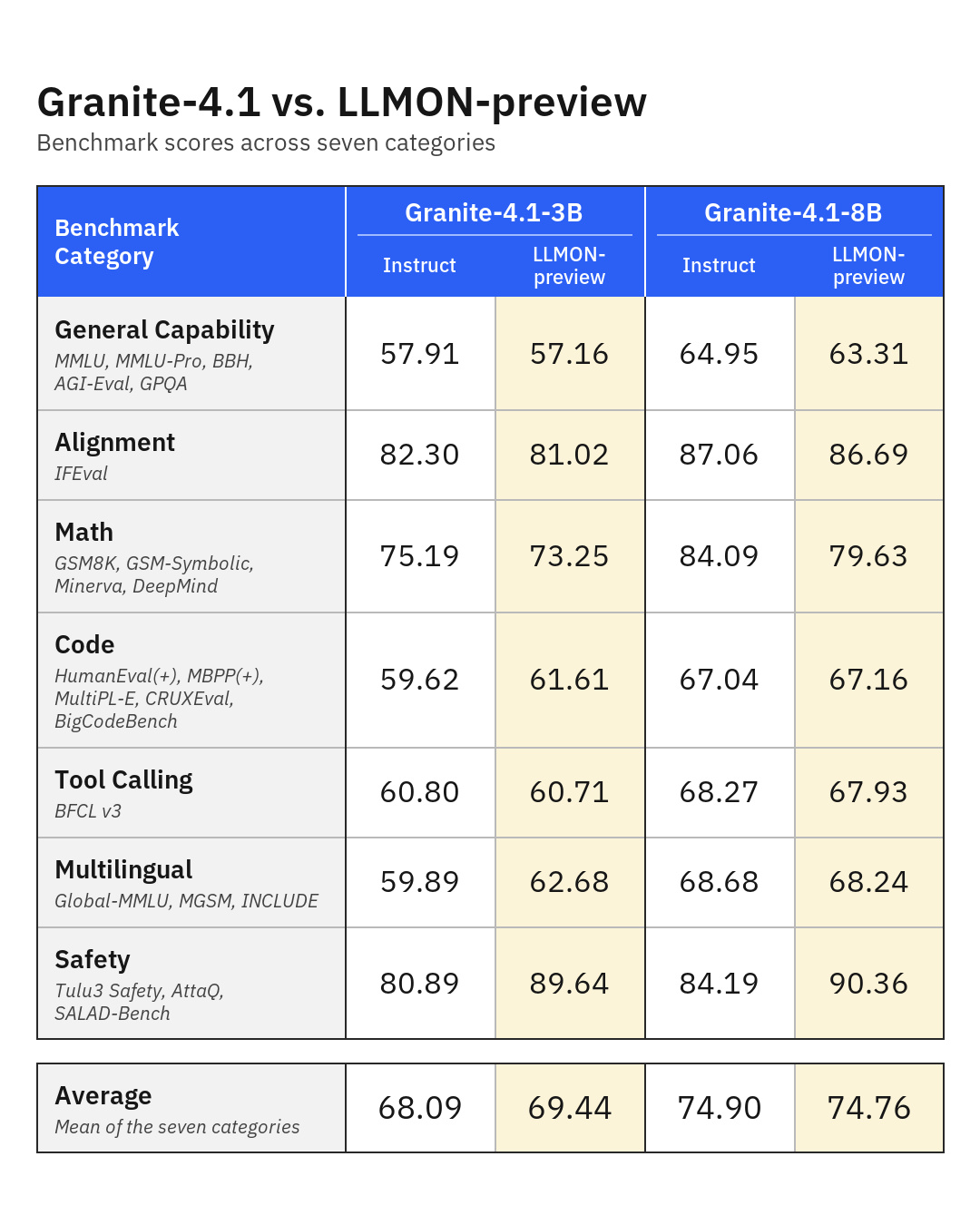
Image: huggingface.co
This evaluation covered attacks that hide predetermined malicious instructions inside data. IBM says it is still improving defenses against attacks that shift strategy across multiple conversational turns. The company also notes that the ability to tell instructions from data is a learned behavior, not a rule the system enforces by construction.
Where can it be used today?
Developers simply label each part of a conversation as an instruction, as data, or as a constraint. The chat template shipped with the models converts that into LLMON form, so basic use requires no separate conversion step. Teams already managing material as JSON can move between the two formats, content unchanged, using the conversion tool released alongside the models. Mellea, an AI task tooling framework, also supports LLMON.
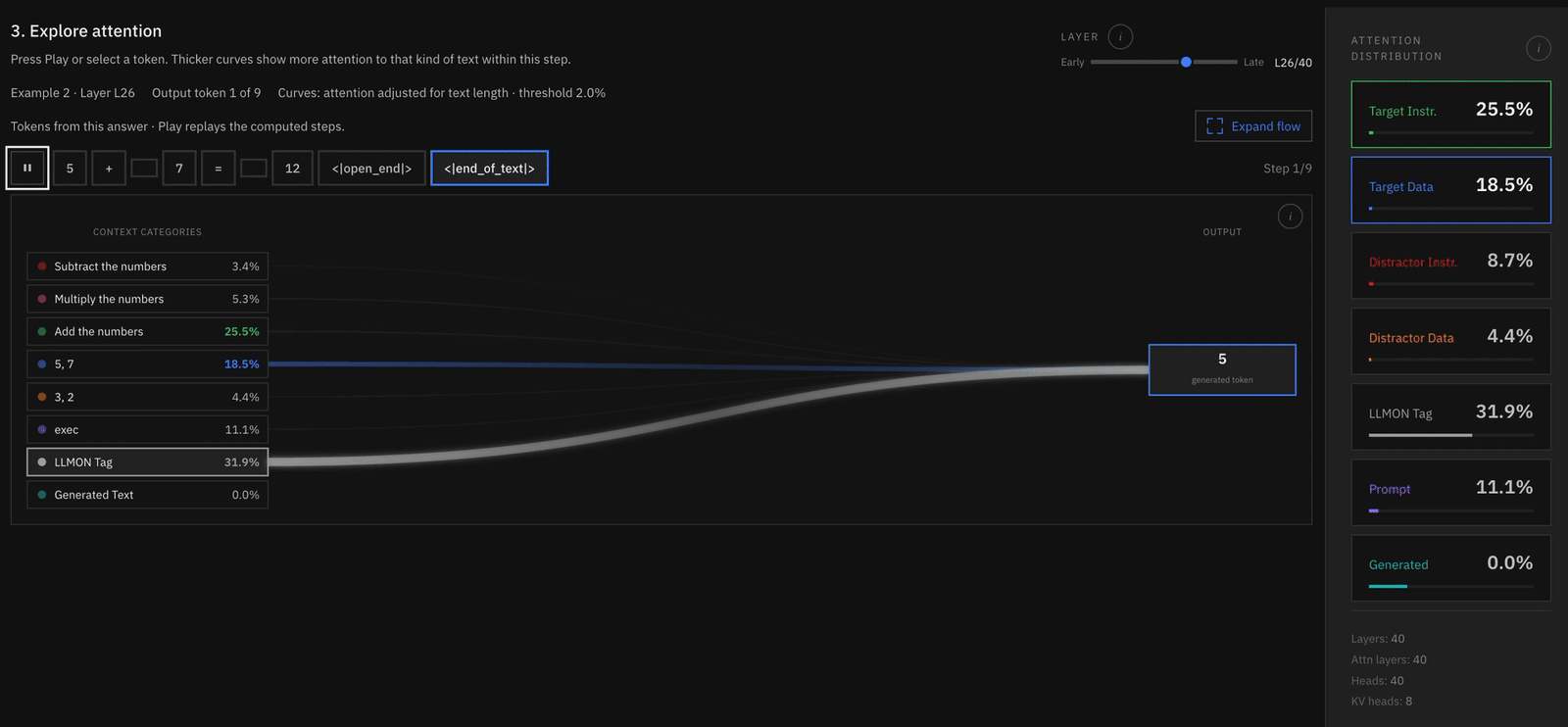
Image: huggingface.co
IBM states plainly that the previews are meant for exploration and evaluation, not production deployment. For developers building AI systems that read documents, the previews offer a way to test how well this defense works. The open question going forward is whether the effect holds up against attacks that unfold over many conversational turns.