OpenAI: GPT-6 Astra Led Proof Development for a Candidate Solution to a 50-Year-Old Problem
Physicist Nathaniel Craig brought the initial idea, and GPT-6 Astra developed it into a concrete method and proof. The proposal still needs expert review and further work before it can be used in real calculations.
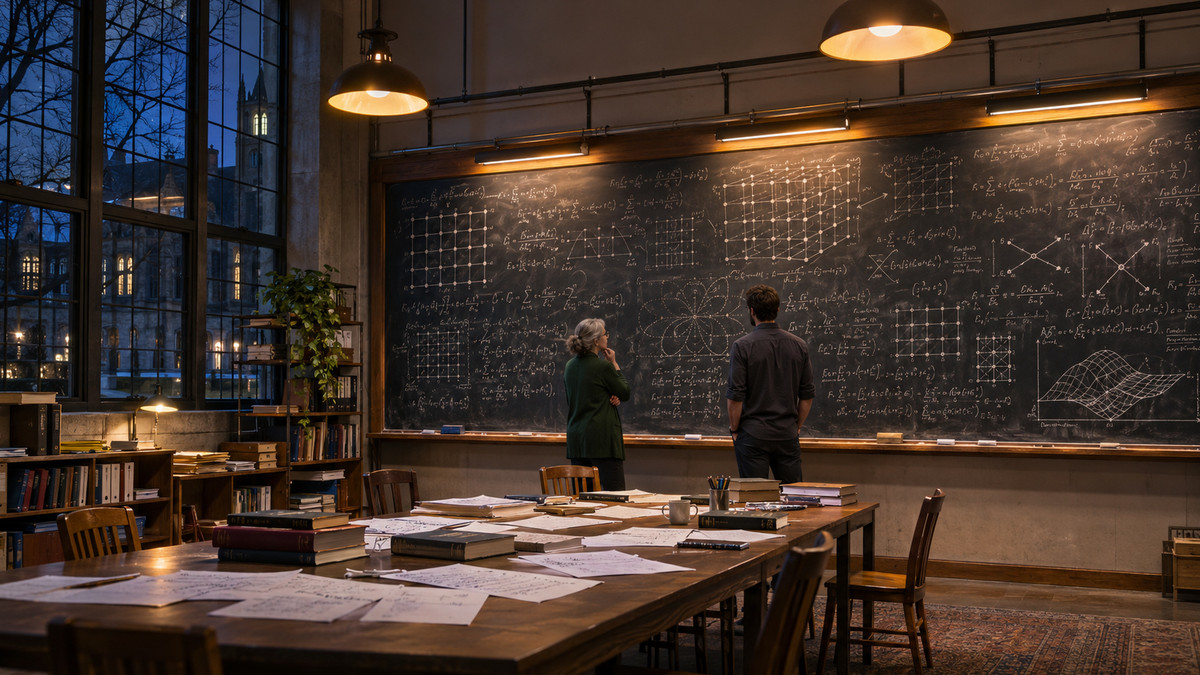
On November 15 local time, OpenAI described a physics research project that GPT-6 Astra took part in. Visiting researcher and physicist Nathaniel Craig proposed a candidate method for defining the Standard Model on a lattice. The Standard Model is modern physics’ foundational theory of matter and forces. A lattice is a framework that carves spacetime into a dense grid of points so that computers can carry out calculations on it. The related preprint was written in October. OpenAI said AI participated in the process of developing a researcher’s initial idea into a concrete construction and proof.
What GPT-6 Astra did
According to OpenAI, Astra’s job was to propose a concrete method and develop the proof. OpenAI says Astra came up with a way to carry force fields onto a finer lattice. OpenAI also said Astra showed that comparisons between lattices converge to a consistent result, and that it led the development of the detailed proof.
Outside experts in lattice field theory also took part in reviewing the proof and raised questions. Craig and Astra developed the idea together over multiple rounds. In that process, Astra proposed a concrete method and led the development of the proof, while outside experts examined the work.
The problem it tackled
The problem the research targeted is defining the Standard Model on a lattice. OpenAI explained that this problem had gone unsolved for more than 50 years. Within it, the question of setting the phases for the full Standard Model had been open for more than 25 years. The new proposal works by comparing lattices to fix the phase rules for particles.
The proposed method holds only under certain conditions. The lattice spacing must be finite, and the field strength at that scale must also be bounded. The research presented a construction that produces a “measure” for the Standard Model under those conditions.
Can it be used in actual calculations?
Putting it to work in real lattice simulations will require further research. OpenAI presented the proposal as a candidate definition that needs expert review. Whether it satisfies a mathematical condition known as “reflection positivity” at finite lattice spacing is also up for examination. Applying the results obtained in the proof to actual calculations remains a task for the future.
OpenAI explained that this construction alone does not solve the problem of defining an interacting theory in continuous spacetime.
What is different about this case is that AI helped develop an idea into a concrete method and proof. What to watch next is how well this candidate definition holds up under expert review, and whether it can be used in actual lattice simulations.