SK Telecom Plans Driverless Transport for Cars Without Self-Driving Features at Pyeongtaek Plant in 2027
The car isn't watching the road. The network is, and it sends the driving commands. After trials in a parking facility, SK Telecom plans to deploy the system in logistics operations at KG Mobility's Pyeongtaek plant in 2027.
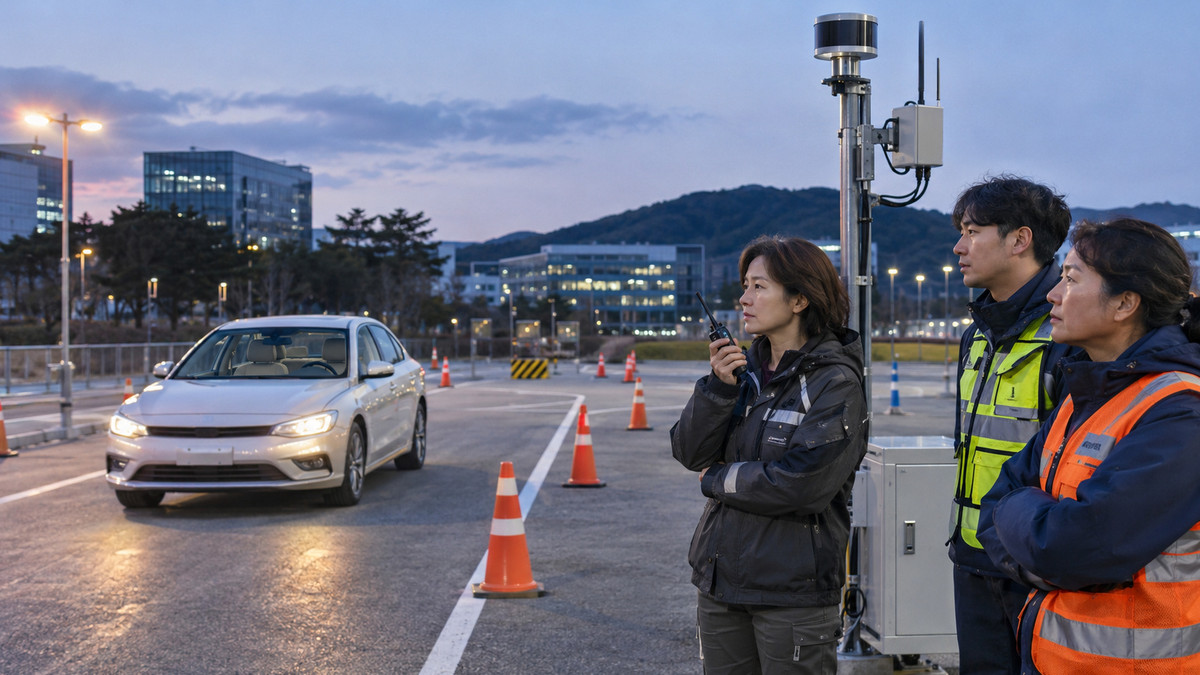
SK Telecom announced on November 18 that it had won a Minister’s Award at Korea’s Radio and Broadcasting Technology Awards for a technology that moves cars without drivers even when the cars themselves have no self-driving features. The winning entry is called AI-RAN-based Autonomous Vehicle Marshalling (AVM) for finished vehicles. The idea is that the mobile network, rather than the car, reads the surrounding environment and controls the vehicle’s movement. The company plans to put the technology to work at KG Mobility’s Pyeongtaek plant in 2027.
How can a car without self-driving features move without a driver?
The driving decisions happen outside the vehicle instead of inside it. AI-RAN is a next-generation network architecture that handles communications and AI processing together. SK Telecom applied it to finished-vehicle logistics, the work of shuttling newly built cars around a site, which people have traditionally done by getting behind the wheel. In its trials, the company says it confirmed that ordinary vehicles with no self-driving features can be moved without a driver.
The lidar units installed around the site are sensors that use light to measure the shape and position of objects in three dimensions. The readings they collect are sent to a base station. The base station uses that data to build a virtual reconstruction of the real space, then calculates the path the car should take and the driving commands required. It then relays steering, acceleration, deceleration, and gear-shift commands to the vehicle over 5G. Everything from scanning the surroundings to issuing driving orders sits on the network side.
From parking-lot trials to factory logistics
The technology was developed and demonstrated last year by SK Telecom together with HFR and Seoul Robotics. SK Telecom handled the technology for running AI close to the site, along with the core AI-RAN components. HFR supplied the base station equipment for private 5G networks. Seoul Robotics provided the lidar-based spatial awareness and vehicle control. The three companies jointly demonstrated autonomous parking at a real parking facility.
According to SK Telecom, the full loop, from sensor data collection to the AI’s decision to delivery of the driving command, completed within the time budget required to control an unmanned vehicle. For factory logistics, it matters not only that the commands move the car, but that they arrive on time.
This year the company is refining the technology in connection with a demonstration project to build out a “hyper AI network” foundation. Building on HFR’s AI-RAN, SK Telecom and Seoul Robotics have set up a test site in Pangyo and are validating the driverless vehicle-moving service there. In 2027, the plan is to build a pioneering AI-RAN network using Ericsson’s 5G technology at KG Mobility’s Pyeongtaek plant and apply it to actual logistics work.
Five awards in a row, and what comes next
With this award, SK Telecom has now received a Minister’s Award at the Radio and Broadcasting Technology Awards five years running, since 2022. The same driverless vehicle-moving technology also took the Most Innovative 5G Service category at last month’s Network X Awards. The company will showcase it at 6G Vision Fest 2026, held in Songdo, Incheon, from December 9 to 11.
The change this technology is aiming at is automating the job of physically driving finished vehicles around a logistics site. Ryu Tak-ki, head of network technology at SK Telecom, said the company will advance the technology further to prove its potential as infrastructure that lets AI carry out physical tasks in real industrial settings. The next test is whether the driverless vehicle moving proven at a parking facility also works in the actual logistics operations at the Pyeongtaek plant.